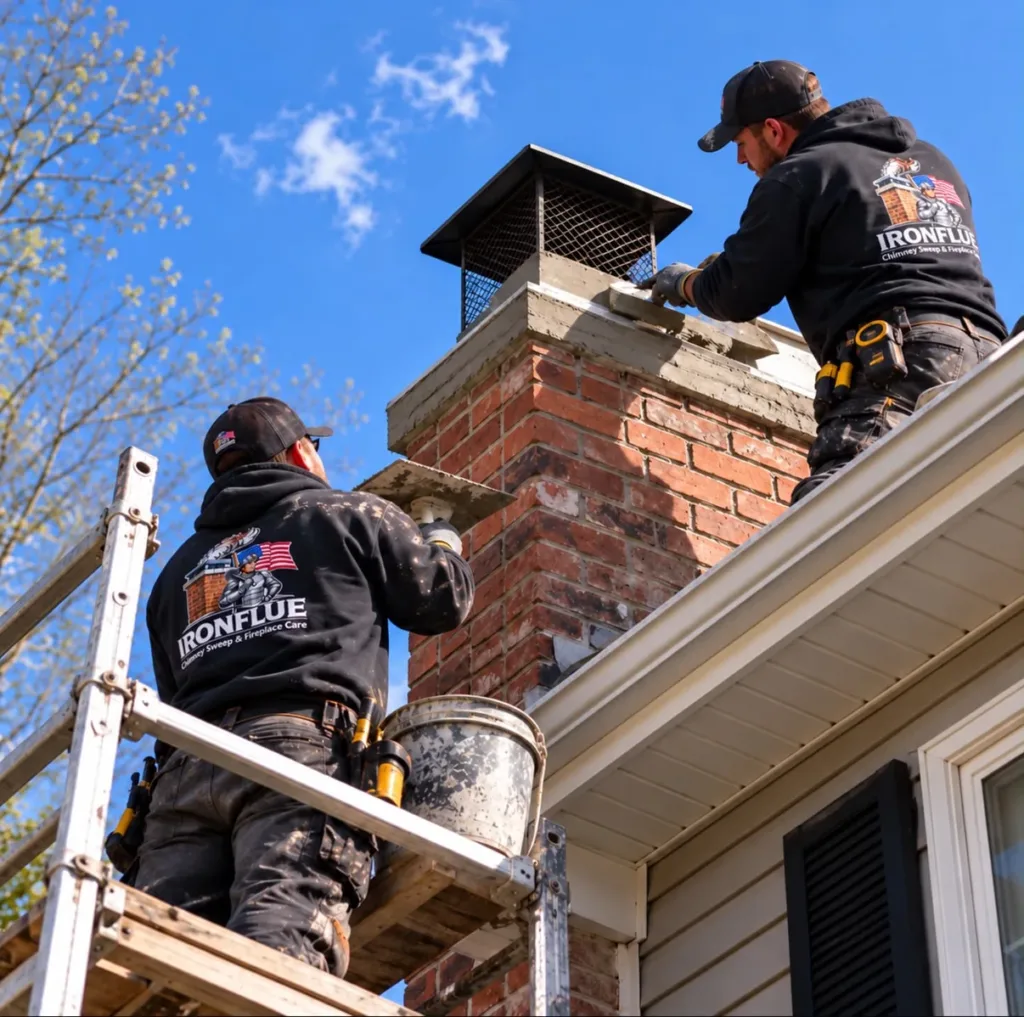
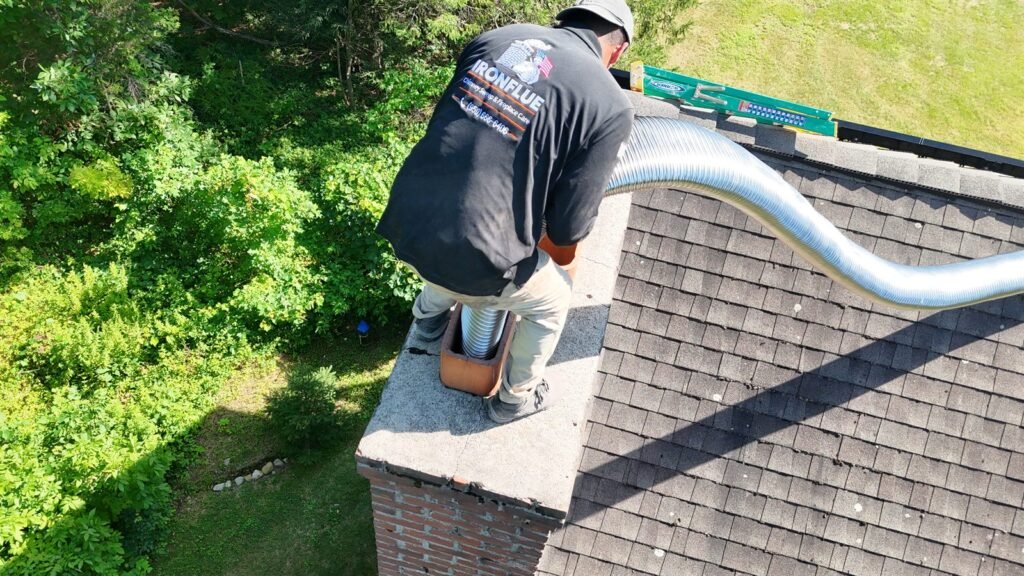
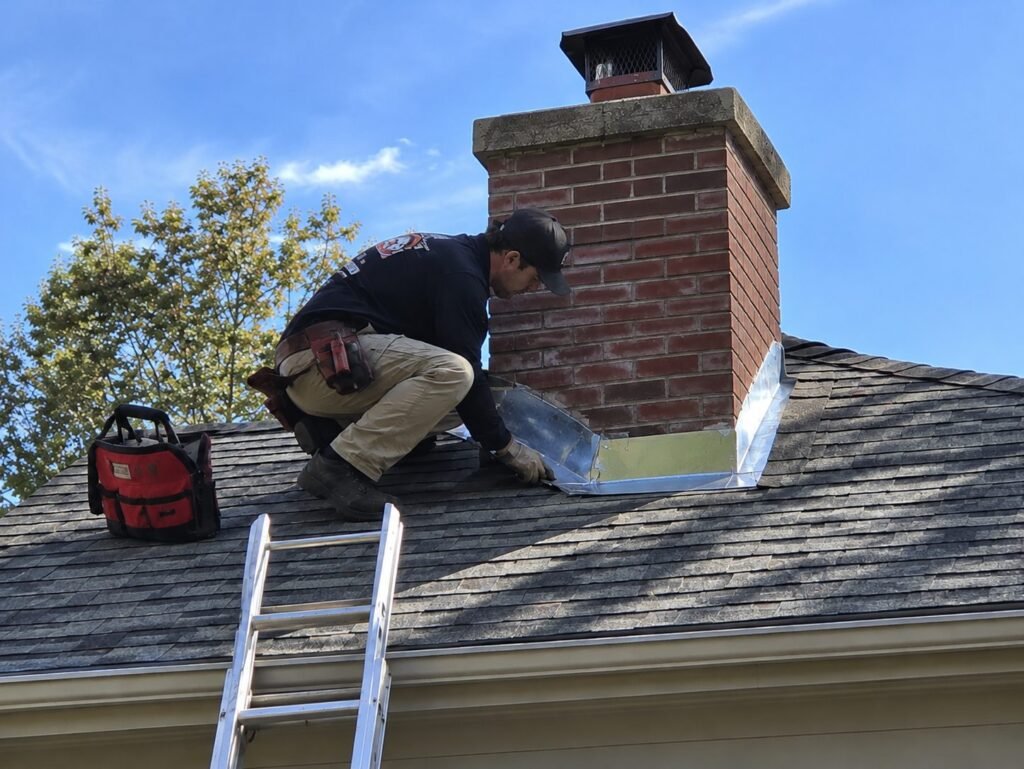
Crumbling joints and flaking brick raise a fair question: can this chimney be patched, or does it have to come down and go back up? The answer depends less on how bad it looks than on what’s causing the damage and whether the structure is still sound. Here’s how the decision usually gets made.
Repair, partial rebuild or full rebuild: what’s the difference?
- Repair. The chimney stays standing. Deteriorated mortar is cut out and replaced, and individual damaged bricks are swapped. The National Park Service (NPS) calls this repointing; it notes that “tuckpointing” is used loosely for the same job but technically means a decorative raised joint (NPS Preservation Brief 2, PDF). See tuckpointing and masonry repair.
- Partial rebuild. The damaged section, usually the exposed top, is taken down to sound masonry and relaid. See partial chimney rebuild.
- Full rebuild. The chimney is taken down to a sound base and built new. See full chimney rebuild.
All three start with the same question, and the NPS brief puts it first: why did the masonry fail? It warns that repointing alone won’t solve problems that come from somewhere else, such as leaking roofs or gutters, settlement of the building, rising damp or extreme weather exposure. Unless the cause is fixed first, the deterioration continues and the new work is wasted.
What spalling brick tells you
Spalling is when the face of a brick flakes, pops off in chips or peels away in layers. The usual driver is water. CSIA says water causes more damage to masonry chimneys than fire does, that common brick absorbs water like a sponge, and that defective mortar joints or the wrong mortar or brick can greatly increase that absorption (CSIA on water damage).
The NPS explains two ways that water does the damage. As moisture evaporates it leaves salts behind, and salts crystallizing inside a brick create pressure that can make the surface spall. And once a brick loses its hard outer surface, water soaks into the softer core and freeze-thaw cycles break it down further (NPS, common problems with brick masonry). If you still need to find where the water is getting in, our guide to signs of a chimney leak walks through the usual entry points.
A handful of spalled bricks in an otherwise solid chimney is usually a repair: replace the units and stop the water. Spalling across many courses, especially alongside soft, recessed joints, usually points toward relaying that section.
Missing mortar: when is repointing enough?
Mortar joints are meant to wear out before the brick does. The NPS brief describes them as sacrificial and expects them to need repointing at some point. Done properly, its guidance is specific:
- Old mortar is removed to a depth of 2 to 2½ times the joint width, which for most brick joints means roughly ½ to 1 inch.
- New mortar should be softer and more vapor-permeable than the brick, and no harder than the original mortar, so stress and moisture move through the joints instead of the bricks.
- Spot repointing is preferred, but once 25 to 50 percent or more of a wall needs it, repointing the whole wall may be more cost-effective, and total repointing can make more sense when access needs scaffolding.
- A good repointing job is meant to last at least 30 years.
Repointing is the right call when the bricks are sound and the chimney is straight and solid. It isn’t the right call when the bricks themselves are failing or the structure has moved.
What if the chimney is leaning or pulling away?
Movement changes the conversation. HUD’s inspection standard for assisted housing lists a chimney that is misaligned, detached, leaning away from the building or in danger of collapse as a sign of structural failure (HUD NSPIRE chimney standard, PDF). Fresh mortar can’t straighten a chimney, and the NPS names settlement among the root causes that have to be dealt with before masonry work.
A rebuild may mean looking at what’s underneath. Connecticut’s building code requires masonry chimney footings of concrete or solid masonry at least 12 inches thick, extending at least 6 inches beyond the face of the foundation or support wall on all sides (2022 CT State Building Code, IRC Chapter 10). Until it’s assessed, keep people and cars out from under a chimney that has visibly shifted.
CSIA recommends a Level 2 inspection after a weather or seismic event, or any malfunction likely to have damaged the chimney. It includes the roof, accessible attic spaces and a video scan of the flue (CSIA Level 2 SOP, PDF). That’s the visit to book before choosing between repair and rebuild: a Level 2 camera inspection.
What decides repair versus rebuild?
Sound brick, worn joints
The chimney is plumb, the bricks are hard and intact, and the trouble is eroded or cracked mortar. Fix the water source, then repoint the failed joints and replace the odd damaged unit. This is repair territory.
Damage concentrated at the top
The exposed upper section has loose or spalled brick and a failing crown, while lower courses are solid. Taking the top down to sound masonry and relaying it, with a new crown built to code, is a partial rebuild.
Movement or widespread failure
The chimney leans, has pulled away from the house, or is spalling from top to bottom. Repointing can’t correct that. Expect a full rebuild, with the footing and the flue liner both on the table.
Two other questions often tip the decision. Will the flue be relined? CSIA recommends a Level 2 inspection before lining or relining, including a check that the flue is sized for the appliance, and it’s far easier to settle that while the chimney is open. And will the rebuilt top meet today’s rules, which may mean a different height or crown than the old one had?
What does a rebuilt chimney have to meet?
New masonry is generally expected to meet the current code, and your town’s building official has the final word. The 2021 IRC portion of Connecticut’s 2022 State Building Code includes these requirements:
- Height. At least 3 feet above the highest point where the chimney passes through the roof, and at least 2 feet higher than any part of the building within 10 feet.
- Cap. A concrete, metal or stone cap (often called the crown) sloped to shed water, with a drip edge and a caulked bond break around the flue liners. CSIA notes the bond break lets the flue expand vertically. See chimney crown repair.
- Walls. Solid masonry units, or hollow units grouted solid, at least 4 inches nominal thickness.
- Cricket. A small peaked structure on the roof behind the chimney that steers water around it, required when the chimney is more than 30 inches wide parallel to the ridge.
- Clearance. At least 2 inches of airspace between combustible materials and any part of the chimney inside the house or within an exterior wall.
Do you need a permit for chimney work in Connecticut?
Often, yes, but ask your town. Under Connecticut General Statutes section 29-263, no building or structure may be constructed or altered until a permit is issued, except as the State Building Code provides (CGS § 29-263). The code exempts some ordinary repairs, and towns publish their own lists of exempt work, so routine repointing may be treated differently from a rebuild. A partial or full rebuild is the kind of alteration to raise with the building department before work starts.
The same statute bars a permit for a contractor who must be registered unless the contractor’s Department of Consumer Protection registration number is on the application. For what else belongs in the paperwork, see our guide to reading a chimney repair quote.
Wondering whether your Connecticut chimney needs repointing or a rebuild? Ask us to take a look. You’ll get photos of what we find, explained in plain language, and a written scope before any repair begins.