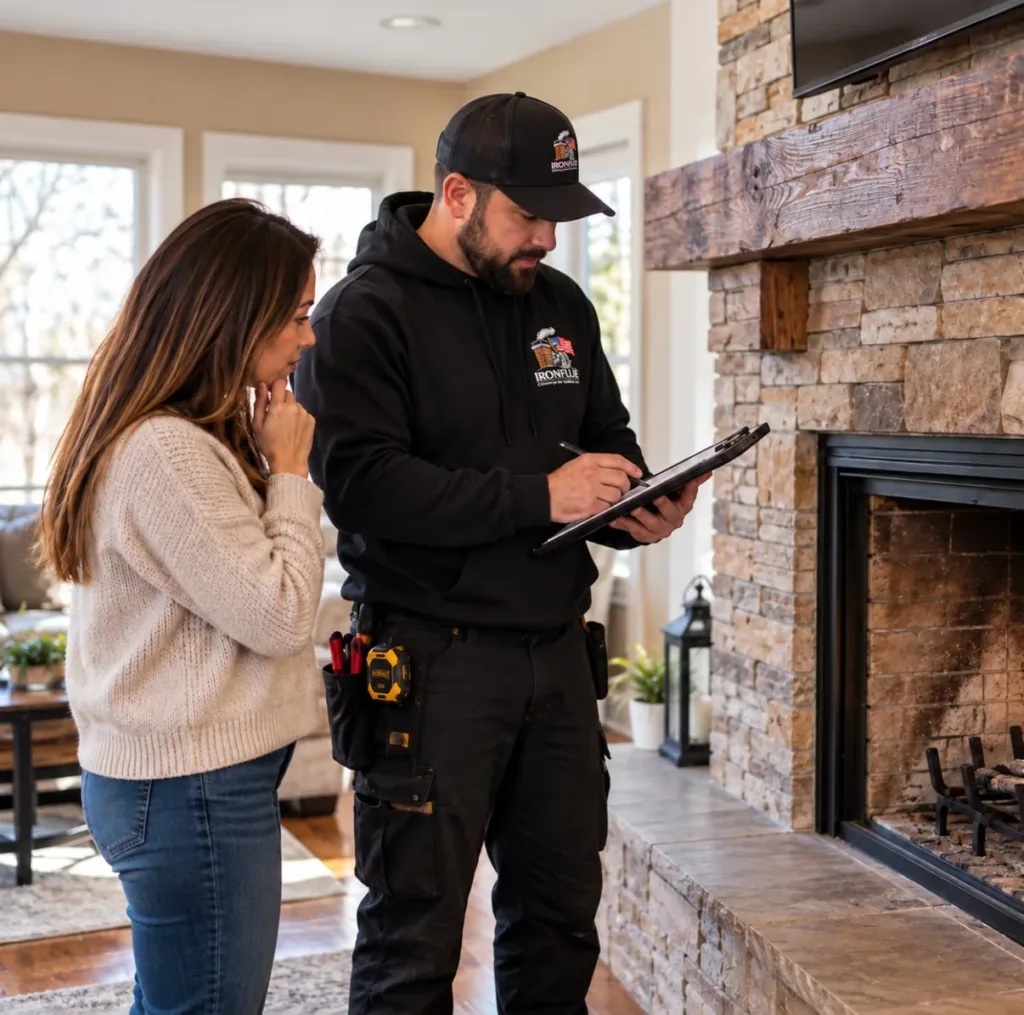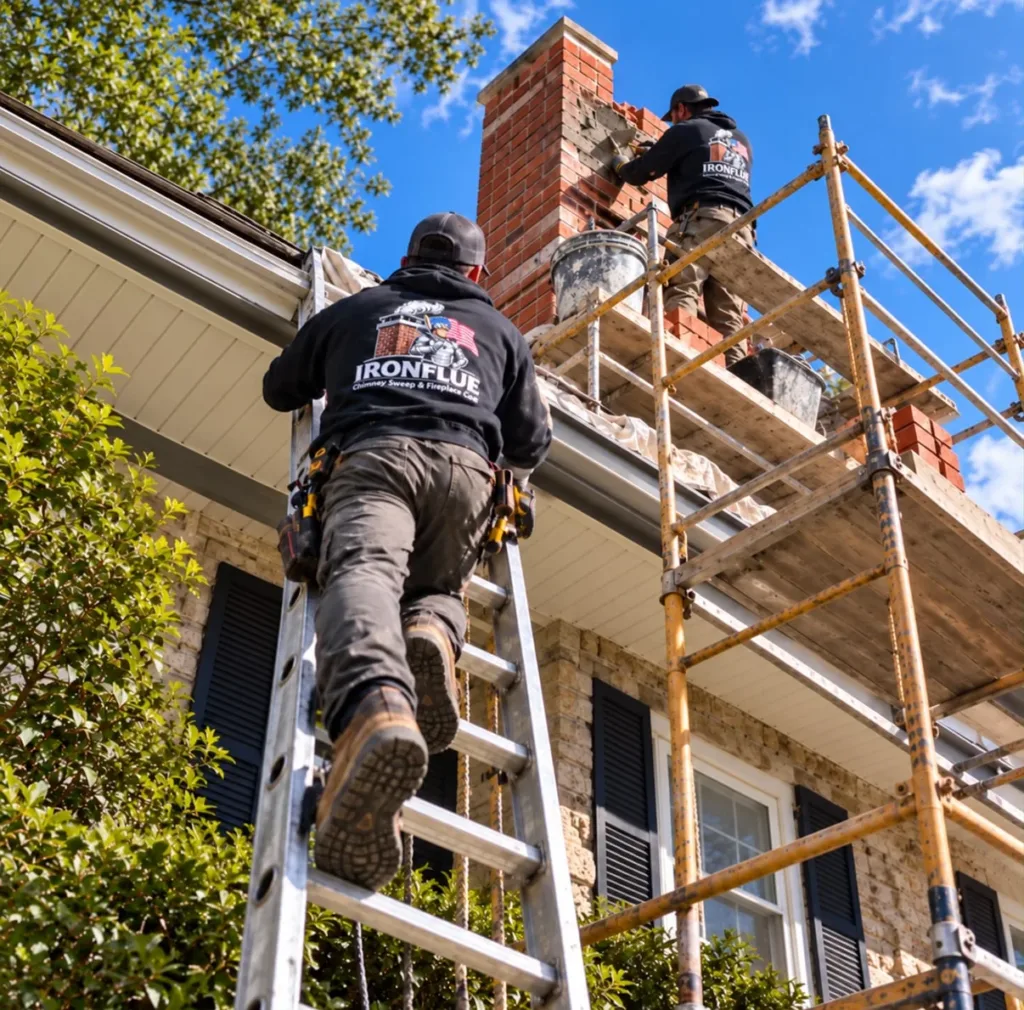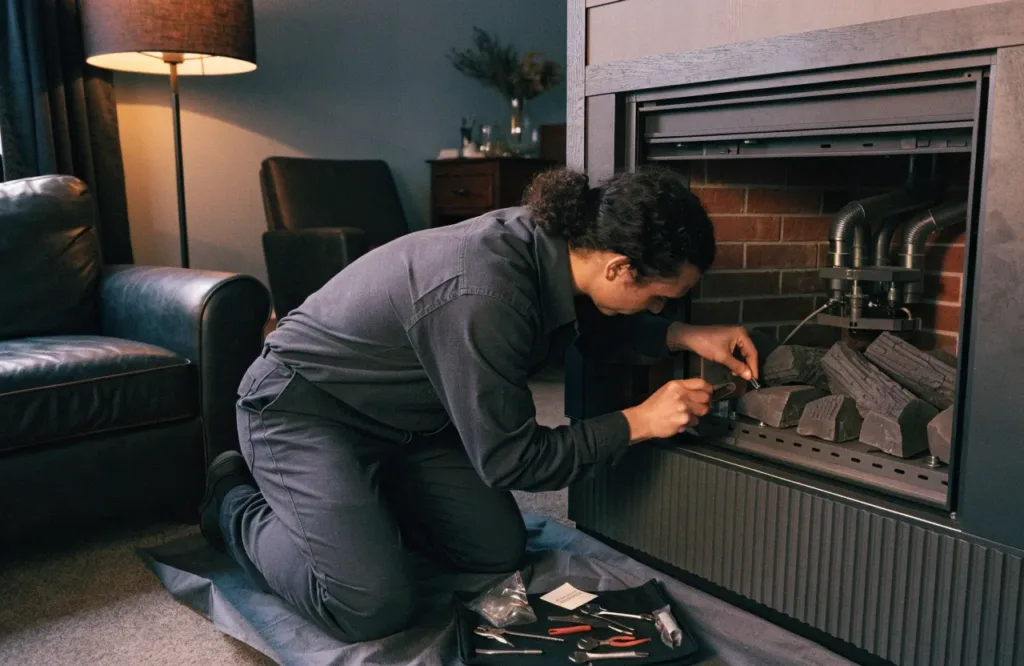
A fireplace looks great in listing photos, but the chimney behind it is one of the hardest parts of a house to judge at a showing. Most of it sits inside walls, above ceilings or up on the roof. This guide covers what your home inspection will and won’t tell you about it, which chimney inspection fits a sale, and how to fit one into a purchase in Connecticut.
What does a home inspection cover on a chimney?
Home inspectors work to a written standard of practice. Under the American Society of Home Inspectors (ASHI) standard, the inspector inspects fuel-burning fireplaces, stoves and fireplace inserts, fuel-burning accessories installed in fireplaces, and chimneys and vent systems. Chimneys also appear in the roofing section (ASHI Standard of Practice).
The same standard lists what the inspector is not required to do. For fireplaces and chimneys, that includes:
- inspecting the interiors of vent systems, flues and chimneys that are not readily accessible
- inspecting fire screens and doors
- inspecting combustion air components or judging whether they’re adequate
- determining draft characteristics (how well the chimney pulls smoke up and out)
- moving fireplace inserts, stoves or firebox contents
“Readily accessible” has a specific meaning in the standard: available for visual inspection without moving personal property, dismantling, destructive measures, or actions likely to put people or property at risk. So a home inspection reports on what can be seen that way. It isn’t designed to evaluate the full length of the flue, the channel that carries smoke from the firebox to the top of the chimney. That’s the job of a chimney inspection.
Connecticut’s seller disclosure form tells buyers to have the property inspected by a licensed home inspector. Do that, and treat the chimney inspection as an addition to it, not a replacement. Your inspection agreement should name the standard your inspector follows.
Why a home sale calls for a Level 2 chimney inspection
NFPA 211, the national standard for chimneys and fireplaces, defines levels of chimney inspection. In its procedure for Level 2 inspections, CSIA (the Chimney Safety Institute of America) says a Level 2 is recommended when the property is being sold. It’s also recommended when an appliance is added or replaced with a different type or fuel, before lining or relining, and after a building or chimney fire, a weather or seismic event, or a malfunction likely to have caused damage (CSIA Level 2 SOP, PDF).
CSIA describes the primary focus of a Level 2 as deciding whether the chimney is suitable for continued use under new or changed conditions. A change of owner fits that description: you don’t know how the system has been used, and you may plan to use it differently. A Level 2 includes everything in a Level 1 inspection and adds a good deal more. Our real-estate chimney inspection is built around it.
What a Level 2 chimney inspection includes
Using CSIA’s procedure as the outline, expect the inspector to cover:
- A video scan of the flue. A camera inspection of the chimney interior is required. The inspector looks for cracks or gaps in the liner (the clay tile or metal lining that contains smoke and heat), unused openings called thimbles that should be sealed, and offsets that are too sharp or make the flue narrower. If the flue can’t be scanned because of its size or multiple offsets, the report should say so.
- The top of the chimney. The crown (the concrete or mortar top that sheds water), the flashing (the metal that seals the joint between chimney and roof) and the cricket, a small ridge on the uphill side that steers water around the chimney, if there is one. Also whether the rain cap restricts the top, whether the termination height is correct, and whether neighboring flues show obvious damage.
- Flue sizing. Measuring the liner and the flue height to decide whether the flue is properly sized for the appliance it serves.
- The attic, basement and crawl spaces. Inspection within accessible attics is required: clearances where the chimney passes through the floor and roof, electrical wires touching the chimney, and water damage, especially just below the flashing.
- Appliances and clearances. The condition of stoves and inserts (door gaskets, baffles, glass, firebrick), dampers that operate freely, and distance to combustible material. For an unlisted appliance, CSIA notes that local code normally calls for 36 inches in all directions; a listed appliance follows its installation manual or data plate. Floor protection under a wood stove should extend 18 inches beyond it in all directions unless the stove’s listing says otherwise.
- The outside of the chimney. Clean-out doors that close tightly, the outside air supply if one is installed, and staining where the chimney’s shoulder tapers that could point to water entry.
CSIA’s procedure ends with the inspector discussing the findings with the client and handing over a copy of the report. With our Level 2 camera inspection, you get photos of each finding and a plain-language explanation of what it means.
How to fit a chimney inspection into your inspection window
Your purchase contract sets the deadline for inspections and for raising problems with the seller, and your agent or attorney can confirm the exact dates. Book the chimney inspection as soon as the contract is signed, ideally close to the home inspection, so both reports arrive while you can still act on them.
Access is the usual hold-up. A Level 2 requires the inspector to go on the roof and into accessible attics, basements and crawl spaces, and it may involve opening panels or doors with common tools. Ask your agent to confirm with the seller’s side that those areas will be reachable. If an area can’t be accessed, CSIA’s procedure has the inspector note the exception and the reason in the report, so you know exactly what remains unseen.
If the inspection turns up work, you need something concrete to bring to the seller. We give you a written scope before any repair and confirm price and scope before anything is booked, whether the finding calls for chimney repair such as crown or flashing work, or liner repair or relining.
Which records should you ask the seller for?
In Connecticut, the seller of a home with four or fewer dwelling units must give you the Department of Consumer Protection’s Residential Property Condition Report before you sign a binder or contract. Its building section asks directly about “chimney, fireplace, wood or coal stove problems,” and other questions cover fuel types and heating system problems, smoke and carbon monoxide detectors, and fire or smoke damage (CT DCP Residential Property Condition Report, PDF). Read those answers before the inspection and share them with your chimney inspector.
The form also advises buyers to check with the town’s building official that permits and certificates of occupancy were issued for work on the property. That check is worth making for a newer wood stove, insert or chimney liner. Beyond the form, ask for:
- Past chimney reports. Inspection reports with dates, plus any photos or video.
- Sweep and repair invoices. What was done, by whom and when.
- Liner paperwork. For a relined chimney, the liner’s make and the installation documents.
- Appliance manuals. CSIA’s procedure notes that clearances for a listed stove or insert come from its installation manual or data plate, and it asks homeowners to provide the manufacturer’s instructions when possible.
- Gas service records. Dates and notes from any service on a gas fireplace or gas logs.
Chimney red flags to note at a showing
You can’t inspect a flue during a walkthrough, but some things are visible and worth writing down for your inspector:
- Stains on ceilings or walls next to the chimney, or staining on the outside where the chimney steps in at its shoulder. CSIA’s procedure treats both as possible signs of water entry.
- A damper that won’t open or close fully.
- Cracked firebrick, cracked stove glass, or a stove door with a worn gasket.
- A stove or insert sitting close to walls or furniture, or with no floor protection under it.
- Smoke marks on the fireplace face or mantel. The disclosure form asks about fire and smoke damage, so compare what you see with the seller’s answer.
- An “unknown” answer to the chimney question for a fireplace that has clearly been in regular use.
None of these alone tells you what a repair involves. That’s what the inspection is for. Once the keys are yours, our fall checklist for getting a fireplace ready for winter covers firewood, alarms and the first fire.
Buying a home in Connecticut? Send us the address and your inspection deadline, and we’ll confirm price and scope before we book the visit.