Getting a fireplace ready for winter is mostly a fall job. The inspection, the firewood and the safety gear all need some lead time, and none of it is fun to sort out on the first cold night. Here’s the order we’d tackle it in a Connecticut home.
When should you start preparing your fireplace for winter?
Earlier than most people think, and firewood is the reason. Connecticut’s Department of Energy and Environmental Protection (DEEP) says softwoods such as pine need at least six months to dry, and hardwoods such as oak need at least a year (DEEP, January 2026). The wood you burn this winter should ideally have been split and stacked last year.
A firewood buying guide on DEEP’s forestry site adds a practical warning: people who wait until the first frost to buy may have trouble finding wood, often pay more, and are more likely to end up with green (unseasoned) wood (Tips for Buying Firewood, PDF). The same logic applies to the chimney. Booking the inspection well before your first planned fire leaves room to handle a repair without losing part of the season.
Book the yearly chimney inspection, and a sweep if it’s needed
NFPA 211, the national standard for chimneys and fireplaces, says chimneys, fireplaces and vents should be inspected at least once a year, and the Chimney Safety Institute of America (CSIA) notes that this includes chimneys serving gas appliances (CSIA homeowner resources). The U.S. Fire Administration gives the same advice: have your chimney inspected and cleaned each year by a professional (USFA fireplace and wood stove safety card).
If nothing about the house or the heating setup has changed, the yearly visit is a Level 1 chimney inspection. CSIA’s guidance calls for a deeper Level 2 when a property is being sold, when an appliance or fuel is changing, or after a chimney fire, a severe weather event or a malfunction that may have caused damage. If you bought the house this year, our guide to chimney inspections when buying a house explains what that deeper check covers.
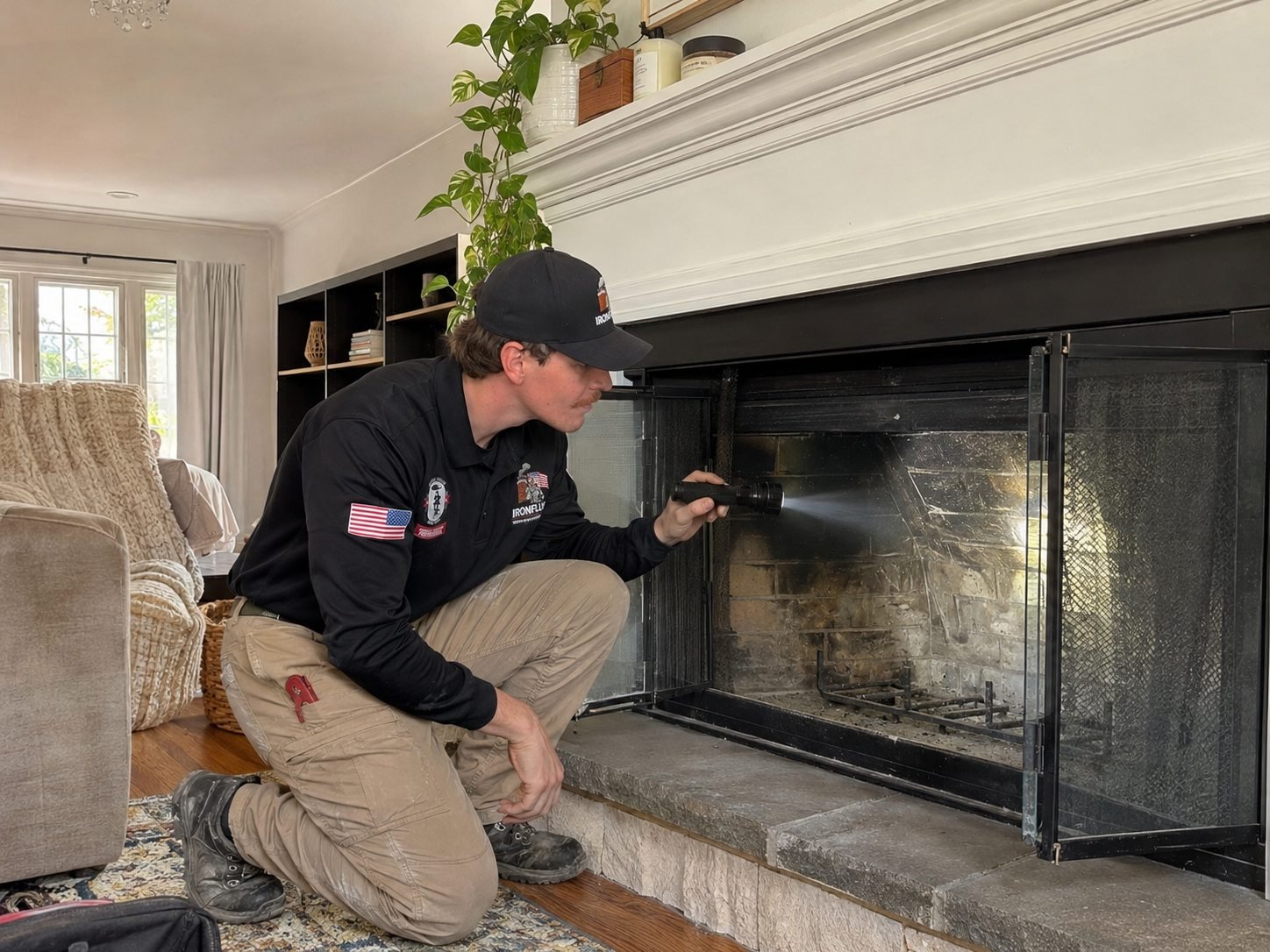
The inspection tells you whether the flue (the passage that carries smoke up and out) needs a chimney sweep before the season starts. CSIA also points out that animals may build nests in a flue, one reason a fireplace that saw little use last winter still deserves a look. We photograph what we find and explain it in plain language, so you can see the inside of your chimney for yourself.
Check the chimney cap and damper
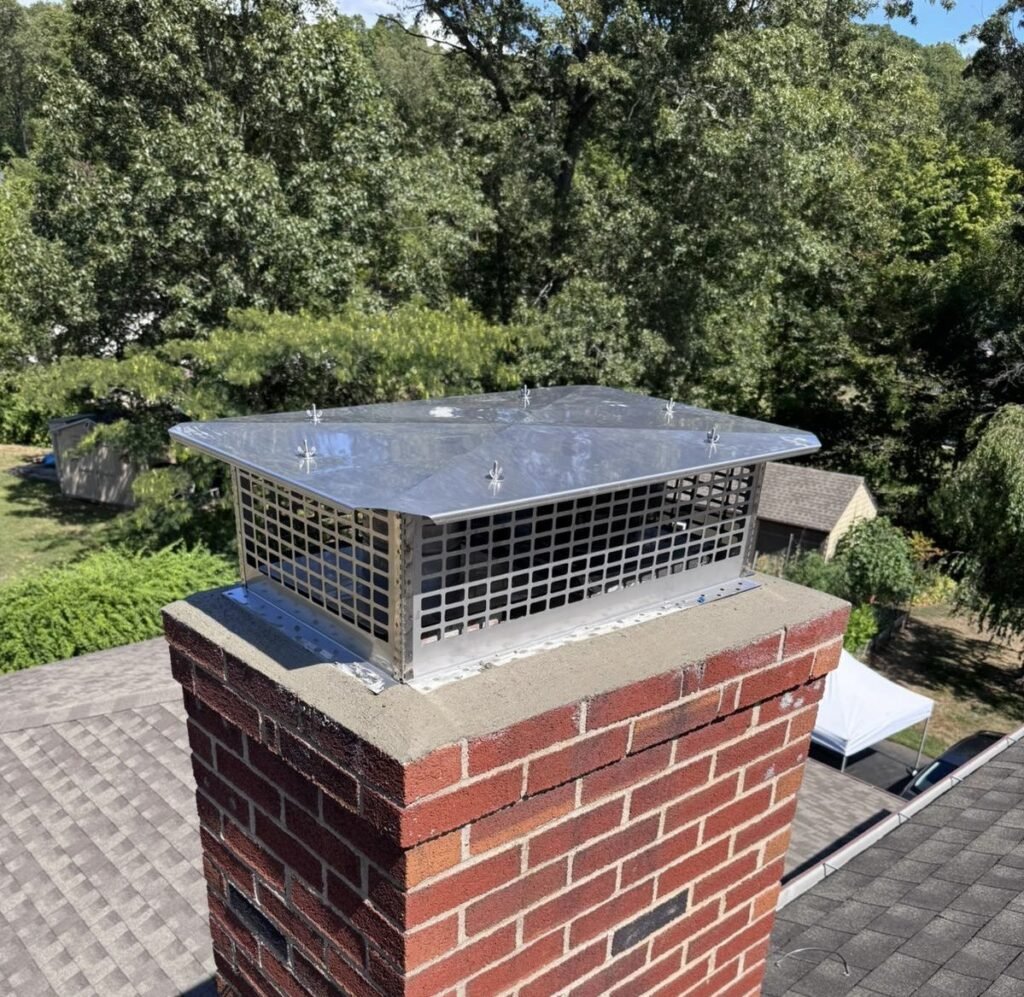
The chimney cap is the cover over the top of the flue. CSIA’s Level 2 procedure has inspectors confirm that a rain cap isn’t obstructed and doesn’t restrict the top of the chimney (CSIA Level 2 SOP, PDF). You don’t need to climb up to do a first check: from the yard, look for a cap that’s missing, tilted or packed with debris, and mention it when you book.
CSIA describes the damper as a hinged metal plate or valve that seals the fireplace when it isn’t in use. Before the season, open and close it a few times. It should move freely and close fully. CSIA also notes that a tight-sealing, top-mounted damper (one that closes at the top of the flue instead of just above the firebox) can reduce airflow coming down the chimney, which is worth knowing if you notice cold drafts or fireplace odors. If either needs work, see chimney caps and dampers.
How to buy and store firewood in Connecticut
Connecticut has rules for how firewood is sold. According to the DEEP-hosted buying guide (produced with UConn Extension and the Connecticut Forest & Park Association), state statute 43-27 requires firewood to be sold by weight or by the standard cord, or a fraction of one. A standard cord is 128 cubic feet of compactly piled wood, which works out to a stack 4 feet high, 4 feet deep and 8 feet long. Selling by another measure, such as a “truckload” or “face cord,” is prohibited. Tell the seller what piece length fits your firebox.
The same guide says seasoned wood is defined by law as cut and air dried for at least six months. You can’t see a date on a log, so check the load itself:
- The ends. Cracks or “checks” on the cut ends, some loose bark, and ends that look grey and weathered.
- Weight and sound. Seasoned pieces feel lighter than green ones. Knocked together, they make a hollow or popping sound rather than a dull thud.
- A moisture reading. DEEP recommends an inexpensive moisture meter from a hardware store and burning wood only at 20% moisture or less. EPA Burn Wise says wood burns best below 20%.
- The species. Hardwoods are generally denser and can have up to twice the heat value per cord of softwoods. The guide notes Connecticut’s forests are over 80% hardwood, but it’s still worth asking.
- Where it came from. EPA recommends buying locally cut firewood to reduce the risk of moving invasive forest pests.
Dry wood matters for the chimney, not only for the fire. The guide explains that creosote forms when temperatures in the stovepipe or chimney drop too low and unburned gases in the smoke condense on the walls. Dense smoke from a smoldering fire, caused by too little air or by green wood, produces the most buildup, and once enough has collected, a hot fire can ignite it and start a chimney fire.
For storage, EPA Burn Wise recommends keeping wood outdoors, off the ground, with only the top covered (EPA best wood-burning practices). The DEEP-hosted guide suggests leaving at least 6 inches of air space between piles so they dry faster.
Test your smoke and carbon monoxide alarms
A fireplace you’ll use all winter is a good reason to check every alarm before the season. The U.S. Fire Administration recommends smoke alarms inside and outside each bedroom and sleeping area and on every level of the home, tested monthly. Replace the battery in 9-volt alarms, and the backup battery in hardwired ones, at least once a year, and replace any smoke alarm 10 years from its manufacture date (USFA smoke alarms).
Carbon monoxide (CO) is undetectable to human senses. USFA advises installing CO alarms in a central location outside each separate sleeping area and on every level of the home, and keeping the vents for the furnace, stove and fireplace clear of snow and debris (USFA carbon monoxide poisoning prevention). After a snowstorm, add the fireplace vent to the list of things you dig out.
Set up a safe spot for ashes
Decide where ashes will go before you make any. USFA says to put ashes in a metal container with a lid and place it outside at least 10 feet from your home. EPA adds that the container should sit on a nonflammable surface and that ashes should be removed regularly.
In practice: buy a lidded metal ash can now and pick its spot away from the house, deck and woodpile.
Gas fireplaces and wood stoves need a check too
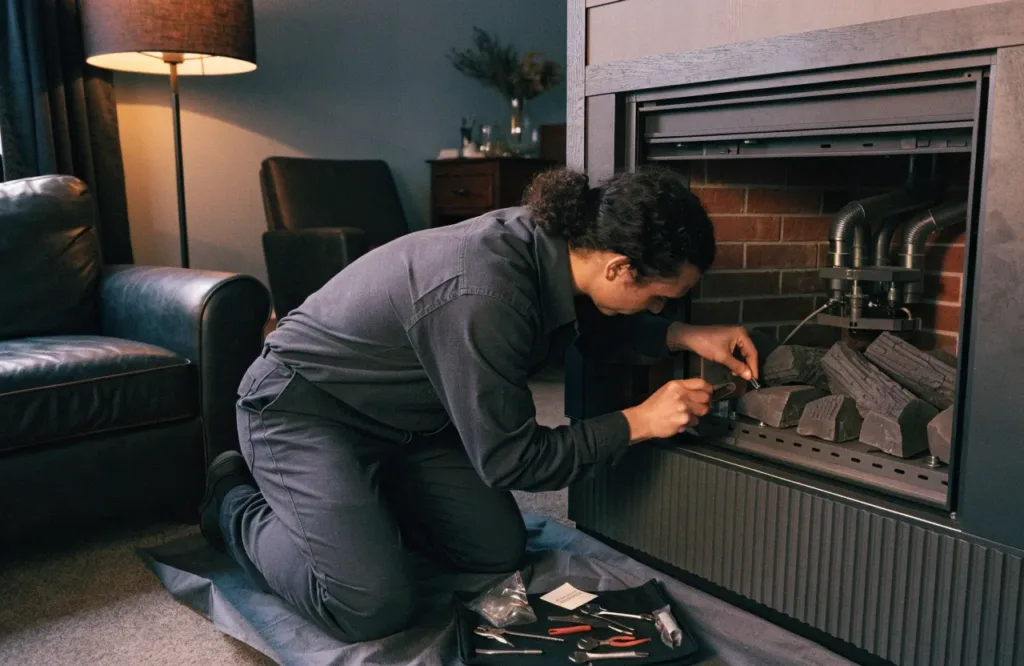
A gas fireplace has no wood to buy and no ashes to carry, but it still has a vent, and the yearly inspection in NFPA 211 covers vents as well as chimneys. Book gas fireplace service before you switch it on for the season. USFA also recommends keeping fireplace “on” switches and remote controls out of the reach of children.
For a wood stove or insert, USFA advises making sure the stove has been tested by a qualified testing laboratory and keeping its doors closed unless you’re loading or stoking the fire. EPA explains why the doors matter: harmful chemicals such as carbon monoxide can be released into your home.
What to check before the first fire of the season
- Look up into the fireplace with a flashlight to confirm the damper is open, as CSIA recommends.
- Move anything that can burn at least 3 feet away from the fireplace or stove (USFA).
- Put a glass or metal screen in front of an open fireplace to keep embers and sparks from jumping out (USFA).
- Start the fire with newspaper, dry kindling or all-natural fire starters, never gasoline, kerosene or charcoal starter (EPA).
- Build a hot fire rather than letting it smolder; EPA calls smoldering fires neither safe nor efficient.
- Keep a fire extinguisher within reach (EPA).
- Put the fire out before you go to sleep or leave the house (USFA).
If smoke spills into the room or the fire won’t draw on that first night, let it go out and have the chimney looked at before you try again.
Want the chimney checked before your first Connecticut fire of the year? Tell us about your fireplace. We confirm price and scope before booking, protect the room while we work, and leave it tidy.